


Your assist helps us to inform the story
From reproductive rights to local weather change to Huge Tech, The Impartial is on the bottom when the story is creating. Whether or not it is investigating the financials of Elon Musk’s pro-Trump PAC or producing our newest documentary, ‘The A Phrase’, which shines a lightweight on the American ladies preventing for reproductive rights, we all know how essential it’s to parse out the details from the messaging.
At such a essential second in US historical past, we want reporters on the bottom. Your donation permits us to maintain sending journalists to talk to either side of the story.
The Impartial is trusted by People throughout your entire political spectrum. And in contrast to many different high quality information shops, we select to not lock People out of our reporting and evaluation with paywalls. We consider high quality journalism must be obtainable to everybody, paid for by those that can afford it.
Your assist makes all of the distinction.
Learn extra
It looks like on daily basis a brand new examine finds tiny plastic particles referred to as microplastics the place they shouldn’t be: in our our bodies and our meals, water and air.
But discovering and figuring out microplastics is extraordinarily difficult, particularly given their small dimension. One microplastic can vary from as giant as a ladybug to as small as an eighth of a pink blood cell.
As well as, it may be onerous for researchers to keep away from unintentionally contaminating their samples, as a result of these plastics are virtually in all places. In consequence, a lot of this analysis could also be overestimating the variety of microplastics.
In a brand new examine revealed in March 2026, our crew discovered that, even when following established protocols, utilizing sure strategies to measure environmental microplastics can doubtlessly contaminate the outcomes.
The examine
We’re chemists on the College of Michigan working in a collaborative crew. We got down to perceive what number of microplastics Michiganders had been inhaling when exterior, and whether or not that relied on the place they lived.
When getting ready our samples, we adopted all the usual protocols whereas conducting our analysis – we averted plastic use within the lab, wore nonplastic clothes and even used a specialised chamber to scale back potential contamination from the laboratory air.
Regardless of these precautions, we discovered plastic counts within the air that had been over 1,000 occasions larger than earlier experiences. We knew these numbers didn’t appear proper, so what occurred?
The perpetrator: Lab gloves
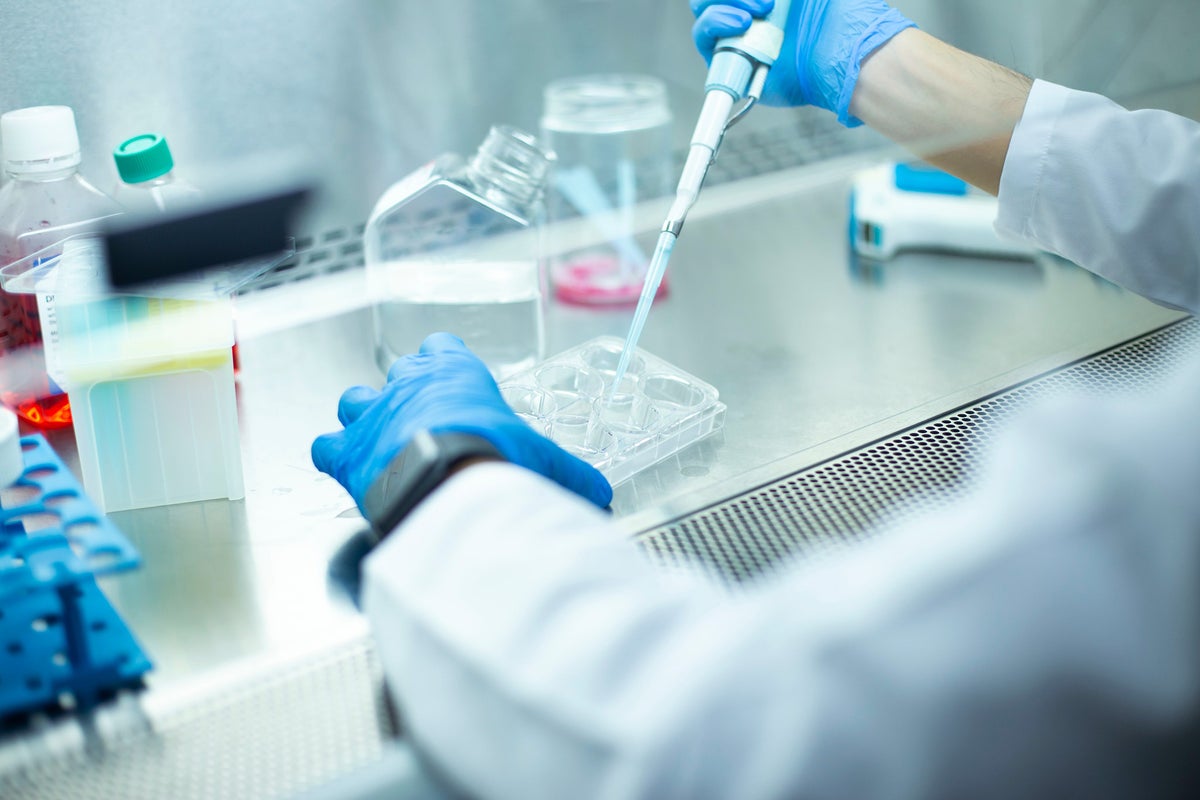
After an extended path to pinpointing the contamination supply, we discovered that laboratory gloves, which the scientific group recommends utilizing as a finest apply, can switch particles to the floor of our samples – on this case, small steel sheets used to gather materials depositing from the air. Furthermore, the particles led to an overestimation of microplastic abundance in our examine.
Right here’s how: The particles, which we recognized as stearate salts, are used to assist the gloves cleanly launch from their mildew throughout the manufacturing course of. When gloves are used to deal with laboratory gear, the particles are transferred to something they contact. Stearate salts are much like cleaning soap molecules – for those who eat plenty of them, they’re in all probability not good for you, however they’re not dangerous within the setting in the identical approach that microplastics are.
Whereas not microplastics themselves, stearate salts are structurally much like polyethylene, the kind of plastic most frequently discovered within the setting. This structural similarity makes it tough to differentiate them utilizing the commonest instruments scientists use to find out whether or not a particle is plastic.
Researchers use vibrational spectroscopy to establish microplastics, which entails measuring how the particle interacts with mild to provide what scientists name a chemical fingerprint.
As a result of polyethylene and stearate salts have very comparable buildings, additionally they work together with mild in an analogous approach.
In consequence, not less than a number of the time, the particles from gloves are incorrectly recognized as microplastics. As extra researchers depend on automated strategies to hurry up their analyses, glove residue could also be more and more mistaken for microplastics, resulting in greater experiences of microplastics within the setting than in actuality.
How widespread is that this contamination?
To research how prevalent this contamination is perhaps, we checked out totally different glove varieties. We mimicked the contact between seven kinds of gloves whereas dealing with laboratory gear and counted the variety of microplastics we’d incorrectly attribute to the setting if we adopted the commonest approaches.
We discovered that gloves can contribute over 7,000 particles per sq. millimeter which can be misidentified as microplastics. This discovering implies that researchers might be unknowingly overestimating microplastic abundance within the setting when dealing with their samples with gloves.
Much more regarding, we discovered that the particles had been largely lower than 5 um in dimension. Microplastics on this dimension vary have bigger impacts on human and ecosystem well being as a result of they’ll extra simply enter cells. By inflating microplastic counts on this dimension vary, utilizing laboratory gloves could jeopardize the research that inform future insurance policies and laws.
Shifting ahead
To keep away from contamination, we propose scientists keep away from glove use whereas conducting microplastic analysis. If that’s not attainable – for instance, with organic samples the place the researchers should put on gloves to guard themselves – we suggest a glove made with out stearates, comparable to these designed for electronics manufacturing. To get better older, doubtlessly contaminated datasets, we’ve got developed strategies to assist differentiate the chemical fingerprints.
Concerning the authors
Anne McNeil is a Professor of Chemistry and Macromolecular Science and Engineering at College of Michigan.
Madeline Clough is a Ph.D. Candidate in Chemistry at College of Michigan.
This text is republished from The Dialog underneath a Artistic Commons license. Learn the unique article.
Science is an iterative course of. New areas of analysis, together with environmental microplastics, introduce new challenges to the scientific group. In addressing these new challenges, we are going to encounter setbacks, comparable to unexpected contamination.
Whereas we needed to discard our preliminary dataset, we count on the teachings we realized about glove contamination to succeed in different scientists. As well as, we plan to proceed our analysis on Michigan’s atmospheric microplastic contamination – however this time with out gloves.
It’s essential to notice that even when the microplastic abundance within the setting is decrease than researchers initially thought, any quantity of microplastics will be troublesome, given their adverse results on human well being and ecosystems.