


Gone are the times when pledges from corporations to energy their enterprise with clear electrical energy have been pushed in the beginning by a need to slash emissions and win inexperienced plaudits from clients.
Right now, the motivation is as a lot about chopping prices and boosting resilience. And it’s a development that has been turbocharged by the most recent fossil gasoline disaster triggered by the Iran Battle, which has led to a spike in oil, gasoline, and electrical energy costs, in addition to rising fears that gasoline shortages may quickly unfold throughout economies all around the globe.
That a lot was the important thing message from main specialists who took half in BusinessGreen’s newest Highlight webinar this week, hosted in affiliation with vitality expertise supplier Wattstor, which explored how and why rising numbers of companies are making the shift to 100 per cent renewables a actuality.
It’s a development Sam Kimmins, director of vitality on the Local weather Group, is best positioned than many to testify to. Alongside CDP, the non-profit co-founded the RE:100 marketing campaign greater than a decade in the past, which has seen lots of of corporations publicly decide to transitioning 100 per cent renewable electrical energy by 2050 on the newest, however usually far sooner. RE100 members – together with company giants reminiscent of IKEA, Unilever, and Google – collectively now symbolize over 570TWh of fresh energy demand globally, which if it have been a rustic, would rank because the world’s tenth largest by way of electrical energy demand.
As Kimmins defined, the success of the initiative boils all the way down to the chilly, exhausting realities of working a enterprise through the period of polycrises which have come to characterise the twenty first century.
“Again in 2014, the preliminary members have been saying ‘look, that is the proper factor to do’,” Kimmins mentioned. “They’re now saying – and for the final eight years they have been saying – ‘that is the proper factor to do for our companies’. The prices of renewables have dropped dramatically: 90 per cent for the worth of photo voltaic over the previous decade, for instance. That is now all about value, vitality safety and enterprise resilience.”
Aiming for 100 per cent renewables
Reaching 100 per cent renewables stays a problem, particularly for smaller corporations, given the raft of applied sciences, companies, and rules they should navigate. However the case for doing so has turn out to be ever extra compelling.
“[100 per cent is] a bit extra inspiring,” he mentioned. “Individuals get behind it, but it surely additionally means your whole enterprise is behind it taking motion and serious about it in a systemic method, relatively than only one individual within the sustainability division driving it incrementally. And that is how we have seen such huge shifts around the globe – not solely in company coverage, however within the coverage of governments which have seen the billions of {dollars} that may move into these renewables markets from corporates and the billions of {dollars} in vitality financial savings that it brings. So actually, aiming for 100 per cent is about taking it critically and pondering of it as a system change relatively than a tweak.”
Over the previous decade and a half, these rising political and financial indicators have served to rework the worldwide vitality market. The declining prices and growing availability of fresh vitality and related applied sciences have massively improved the monetary case for both deploying renewables or sourcing renewable energy from suppliers, opening up the marketplace for many extra corporations.
On prime of that, having barely recovered from the financial fallout of the Covid-19 pandemic, two main world crises inside 4 years have introduced into stark focus the large financial risks of relying too closely on worldwide markets tied to the availability of finite fossil fuels from geopolitically unstable areas. First, Russia’s full-scale invasion of Ukraine despatched European nations scrambling to supply different provides of fossil gasoline, sending vitality costs and inflation hovering because of this. Now, whereas nonetheless reeling from that vitality disaster, one more worth shock has reared its ugly head within the wake of the US and Israel’s conflict with Iran, which nearly in a single day knocked out round a fifth of the world’s oil and gasoline provide.
The outcome? But extra hardship for shoppers and companies. Within the UK, the vitality worth cap is anticipated to rise in July, pushing up the standard dual-fuel family vitality invoice by greater than £300 a 12 months. For UK companies, which aren’t protected by the worth cap, the prices are much more eye-watering, with wholesale electrical energy costs roughly 75 per cent increased than they have been 5 years in the past, leaving energy-intensive corporations reminiscent of industrial producers notably uncovered.
Wake-up name
For a lot of, the most recent disaster seems to have been a long-overdue wake-up name: UK demand for photo voltaic panels, warmth pumps and electrical autos (EVs) has shot up over the previous month, as shoppers and companies have sought to curb their publicity to risky vitality and gasoline prices. Some commentators have jokingly advised President Trump – a local weather science denier and one of many world’s fiercest critics of fresh vitality – may truly be a secret renewables business plant.
As Jess Ralston, head of vitality on the Vitality and Local weather Intelligence Models (ECIU), argued through the webinar, the case for corporations to ditch fossil fuels and take higher management over their vitality by renewables and electrification has by no means been stronger.
“I feel it is changing into more and more apparent to the general public, companies and the federal government that internet zero expertise provides not simply that vitality safety, however truly a strategy to stabilise costs,” she mentioned. “Sure, there’s been little pace bumps when world inflation has been by the roof, however we’ll see these applied sciences get even cheaper. So, it is sensible from that enterprise perspective, but it surely additionally helps from that UK-wide vitality resilience perspective, as a result of the extra companies that set up these applied sciences, the much less gasoline we have now to purchase from international locations that we in all probability do not need to purchase from. All that simply implies that, total, the UK is much more vitality safe.”
For Jack Peck, head of UK renewables at Wattstor, the inherent instability of fossil gasoline markets solely additional bolsters the case for renewables. “I feel it is necessary to say that Iran is the present geopolitical disaster, but it surely should not be seen in isolation,” he mentioned. “We have had lockdown from Covid, and likewise Russia and Ukraine, which have had dramatic implications for prices on the usual grid and fossil fuel-based vitality provides. These have been beforehand seen as dependable and low cost sources of vitality – they’re now proving to be something however.”
Navigating a posh market
Rising numbers of corporations are satisfied of the deserves of switching to renewables, however how can they finest make a transition that’s outlined by important complexity and presents companies with a variety of various choices?
“It takes time to study the market, and construct your expertise and experience as an organization, however fortunately there’s now an enormous ecosystem that’s designed to make it simpler for corporations to make the change,” mentioned Kimmins.
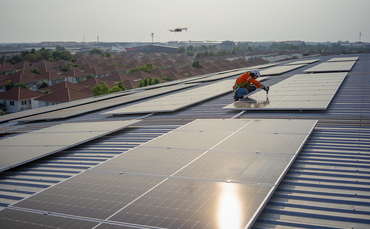
He defined that there are 4 predominant methods for corporations to realize a 100 per cent renewable provide of electrical energy. Most clearly, there’s self-generation, which is often achieved by the set up of rooftop photo voltaic panels and on-site batteries. Then there are energy buy settlement (PPAs), which allow corporations to safe long-term provides immediately from turbines reminiscent of wind and photo voltaic farms. Inexperienced tariffs backed by renewables certificates are another choice, which allow the purchaser – and nobody else – to credibly lay declare to the renewable electrical energy every certificates represents. And eventually, corporations can more and more attain out to a utility or third-party – reminiscent of Wattstor – which offers a bundled product that may mix onsite and offsite renewables suppliers with vitality administration companies to optimise clear vitality use and minimise prices.
As a clear vitality expertise supplier that designs, funds, installs and operates good renewable vitality methods for industrial, industrial, and agricultural companies, Wattstor sits on the epicentre of this rising market – and it’s seeing rising curiosity in its companies, in accordance with Peck. The corporate’s providing combines all the above approaches, tailoring its mixture of companies for various corporations in numerous sectors, which all have completely different wants.
Every strategy provides completely different execs and cons. Renewables certificates have a key position to play for a lot of corporations, notably in supporting local weather targets. However value financial savings might be comparatively modest and such inexperienced tariffs are unlikely to match renewable provides to demand in actual time. Company PPAs can present a lot wanted certainty and stability in risky vitality market, in addition to the reputational advantages of being immediately linked to a venture. Nonetheless, contracts are inherently complicated and there’s a threat of corporations lacking out on a number of the financial savings on supply from rising versatile vitality markets enabling them to shift their demand to inexpensive intervals of the day or evening.
As such, Peck says he’s “a giant advocate of deploying expertise, if companies have the capital to do it”.
From rooftop photo voltaic and warmth pumps to battery storage and constructing vitality administration methods, there are answers that may work collectively to drive down vitality prices and optimise on-site clear energy technology that’s insulated from risky nationwide and worldwide markets. Such efforts may curb corporations’ publicity to non-commodity expenses on vitality payments, which embrace levies associated to grid and coverage prices.
“As long as you’ve got obtained the proper expertise deployed in many alternative methods, then there’s methods which you can truly use that to your benefit and finally make your vitality provide cheaper,” Peck mentioned.
Nonetheless, he additionally harassed that none of those efforts must be checked out in isolation. Corporations electrifying their fleets and heating, whereas higher managing their vitality used and putting in vitality effectivity measures, can reap enormous financial savings from lowering their fossil gasoline publicity additional, whereas additionally enabling them to reap the benefits of revenues from rising versatile vitality markets within the UK. These improvements can then be complemented by PPAs or the sourcing of renewables certificates. Upfront value limitations will also be addressed by more and more frequent financing packages and companies, which may permit onsite applied sciences to be deployed at minimal and even zero value.
“It is necessary that each one these methods can work collectively and work for the advantage of all these applied sciences on website, supplied you’ve got for the proper design and setup to profit from it,” Peck defined. “If you happen to do this in the proper method, then you may get that unit value of electrical energy a lot decrease, and go inexperienced with it within the course of.”
Coverage dangers and alternatives
In fact, regardless of welcome latest progress, the clear vitality transition is not going to be solely market-driven. Authorities coverage, which has been intrinsic to the emergence of renewables over the previous twenty years, will nonetheless have a essential position to play in figuring out the tempo and scale of renewables deployment, even when the transition as an entire is now an unstoppable pressure.
Whereas it’s going through rising strain from some quarters to develop oil and gasoline drilling within the North Sea as a response to the present fossil gasoline vitality disaster, the Labour authorities within the UK has stood firmly behind its goal to ship a clear energy grid by 2030. Prime Minister Keir Starmer has repeatedly extolled the virtues of weaning the UK off the “rollercoaster” of worldwide fossil gasoline markets by homegrown clear energy provides.
In distinction, the Conservative Social gathering has joined Reform UK in calling for extra oil and gasoline drilling, restrictions on renewables, and the scrapping of the nation’s legally-binding internet zero targets. Reform UK has gone additional nonetheless, suggesting it may tear up present government-backed clear energy with wind and photo voltaic farm builders. Ought to both of those events lead the following authorities, would companies be pressured to mood their clear vitality ambitions?
Raltson identified that up to now such coverage threats have finished little to discourage renewables builders, nor has it delay corporations from in search of cleaner vitality provides. The identical goes for the US, the place regardless of hostile coverage strikes from the Trump administration, photo voltaic installations have continued to surge. “There hasn’t been an enormous drop off in what’s been occurring within the US on account of Trump’s rhetoric,” she mentioned. “And so I might assume it will be comparable within the UK.”
Peck was equally assured that, whereas in a really perfect world supportive insurance policies can and will serve to additional speed up the shift to a extra resilient clear vitality system, that development is unlikely to be stopped in its tracks by a authorities that’s hostile to renewables.
“The market has now matured to such an extent that, notably for front-of-the-meter technology, it’s now not fully reliant on long-term authorities backed contracts,” he mentioned. They’re truly methods of buying and selling that vitality, deploying batteries together with photo voltaic, and shifting in the direction of service provider fashions. And from our aspect, our perspective on the enterprise provide behind the meter, it will be a really courageous, silly authorities that tries to alter the basics of the electrical energy system. They don’t seem to be going to do this. It comes down essentially to economics: if it is cheaper than the choice, then that is finally why companies transfer forward with it.”
The worldwide economic system could also be tormented by uncertainty, volatility, and threat, however renewables, mixed with effectivity measures, are more and more recognised as the one believable mechanism for companies to curb hovering vitality prices and deal with escalating local weather dangers. Shifting to 100 per cent renewables is definitely an bold endeavor, and delivering on the purpose usually requires funding and a mixture of options. However renewables alongside decrease emissions and decreased long run prices, renewables more and more provides companies one thing fossil fuels by no means can: resilience and stability.
BusinessGreen’s Highlight webinar – ‘Making 100 per cent renewables a actuality’ – was hosted in affiliation with Wattstor. It may be watched again in full on demand right here.